

UAEU Researchers Make Local Homes More Sustainable
Mon, 6 June 2022
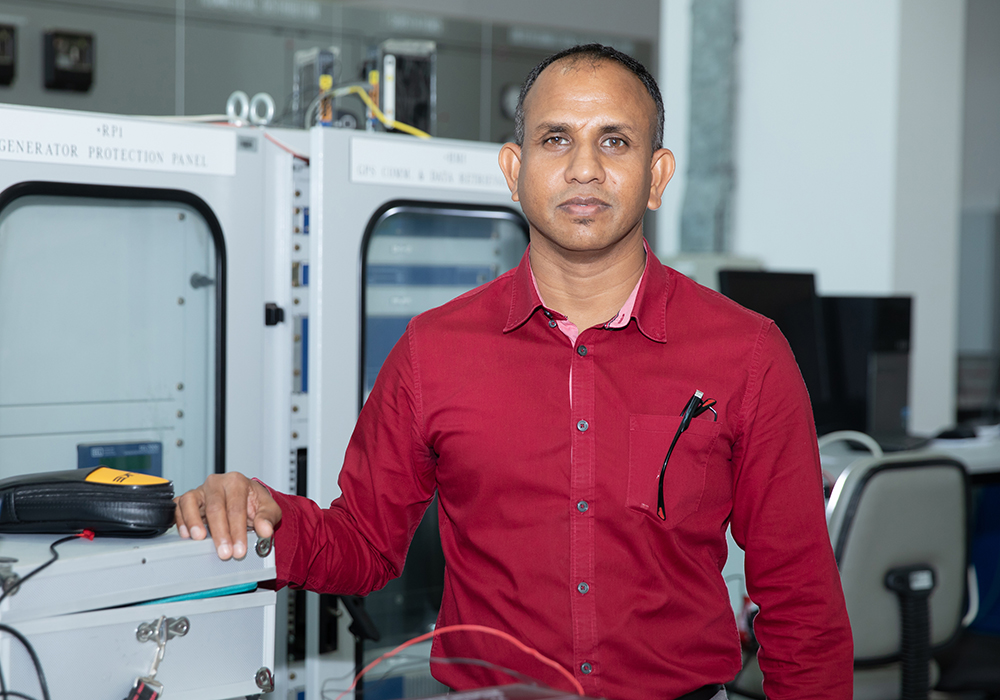
A new smart home energy management system has been developed by researchers at the United Arab Emirates University.
The two-year-project consists of hardware and software that can monitor the occupancy in a house’s various rooms and detect the power consumption from devices wirelessly. A controller receives the information from the monitoring device and the occupancy information from different sensors in the room. “It has a rule-based intelligent algorithm that can operate your devices,” said Dr Hussain Shareef, Associate Professor at the College of Electrical Engineering. “For instance, if you have lights, water heaters and air conditioners, it processes the information. If there is nobody there and you forgot to turn off the air conditioner or adjust the thermostat, it can adjust the temperature based on the settings given to the program, and make the room temperature at a comfortable level for when you come back home.”
Another element incorporated into the system is the demand response feature, which attempts to decrease the energy consumption from 10am to 4pm, for instance, due to a high load in the grid system.
In many countries, different prices are placed for different times of the day, which is referred to as the “time of use price for electricity”. Dr Shareef, who previously worked at TNB Research, a renewable energy research center in Malaysia, took this point into consideration by basing it on the calculations from a local utility organization. “So based on the algorithm embedded in our system, we will try to shift the loads,” he explained. “For example, a washing machine can be delayed for a certain time because the price of electricity is a bit high during a particular period of time.”
This type of sustainable feature will be included in the home management system, which Dr Shareef deems vital as electricity prices increase every year. “We are talking about reducing greenhouse emissions to be more environmentally-friendly,” he added. “We should reduce and optimize electricity to make our homes more energy-efficient and more economical.”
A similar system has just been introduced in the UAE, called home automation, although it does not include intelligent algorithms that can perform such tasks. Rather, remotes and phones are used to turn on and off different elements of the house.
“Our system is the next level,” Dr Shareef noted. “We already have a prototype and we are testing it in our lab in Al Ain.”
The next step will include protecting the patent before the commercialization stage.
The next objective will also look to improve the system by integrating the buildings’ integrated renewable energy systems, such as rooftop photovoltaic (BIPV) systems, to further increase the house’s energy efficiency. “It is especially important for the Gulf because it is a very hot environment and requires a lot of air conditioning load,” he concluded. “We also have a lot of potential in the PV systems because it is always sunny so it is better to use such systems more efficiently”.
Do you find this content helpful?
عفوا
لايوجد محتوى عربي لهذه الصفحة
عفوا
يوجد مشكلة في الصفحة التي تحاول الوصول إليها