

Toward Quantitative Hologenomics: New Perspective Published in Science Reveals How Microbiomes Shape Host Biology and Evolution
 In an important new publication, the Holobiont Biology Network – a global collaboration
of 22 researchers from 12 institutions (including an author from Department of Biology,
United Arab Emirates University) – has made significant strides in understanding the
complex relationships between host organisms and their microbiomes. Published in the
Journal Science, the piece sheds new light on how these microbial communities, living in and on their
hosts, play vital roles in shaping host biology, health, and evolutionary processes.
In an important new publication, the Holobiont Biology Network – a global collaboration
of 22 researchers from 12 institutions (including an author from Department of Biology,
United Arab Emirates University) – has made significant strides in understanding the
complex relationships between host organisms and their microbiomes. Published in the
Journal Science, the piece sheds new light on how these microbial communities, living in and on their
hosts, play vital roles in shaping host biology, health, and evolutionary processes.
Led by Prof. Seth R. Bordenstein from the One Health Microbiome Center at The Pennsylvania State University, USA, and including coauthor Dr. Sunil Mundra, Associate Professor at United Arab Emirates University, the researchers show the importance of “holobiont biology”. This newly described concept—holobiont biology - and emerging framework views the host organism and its associated microbiomes – together forming the “holobiont” – as an interconnected biological system that shapes each other’s development and function.
The team revealed that the collective genetic material of host and microbiome, known as the “hologenome,” often explains complex traits and variations that have eluded scientists for years. In many systems, the hologenome accounts for a wider range of phenotypic variations, such as behaviour, metabolic traits, and predispositions to chronic illness, than either the host or microbial genomes alone.
According to the authors, microbiomes are far from passive companions; they actively shape host physiology and can influence evolutionary paths. This new understanding holds promise for applications in sustainable agriculture, conservation biology, and human health by revealing how hosts and microbes co-evolve and influence each other’s traits.
Employing advanced DNA sequencing technologies and innovative data models, it has been shown that microbial genomes affect various host traits, including poison production in newts, insecticide resistance in wasps, and plant growth resilience. The collective findings highlight the potential of hologenomics, a field dedicated to studying the interactions within host-microbiome systems, to address key challenges by fostering ecological resilience and improving agricultural productivity through targeted microbiome management.
The author noted, “This approach broadens our understanding of the influence of microbes on life’s diversity, which could revolutionize how we study complex biological systems.” By embracing this new perspective, the study contributes to an evolving view that positions hosts and their microbiomes within a dynamic, interconnected biological network, thereby transforming traditional studies of host biology.
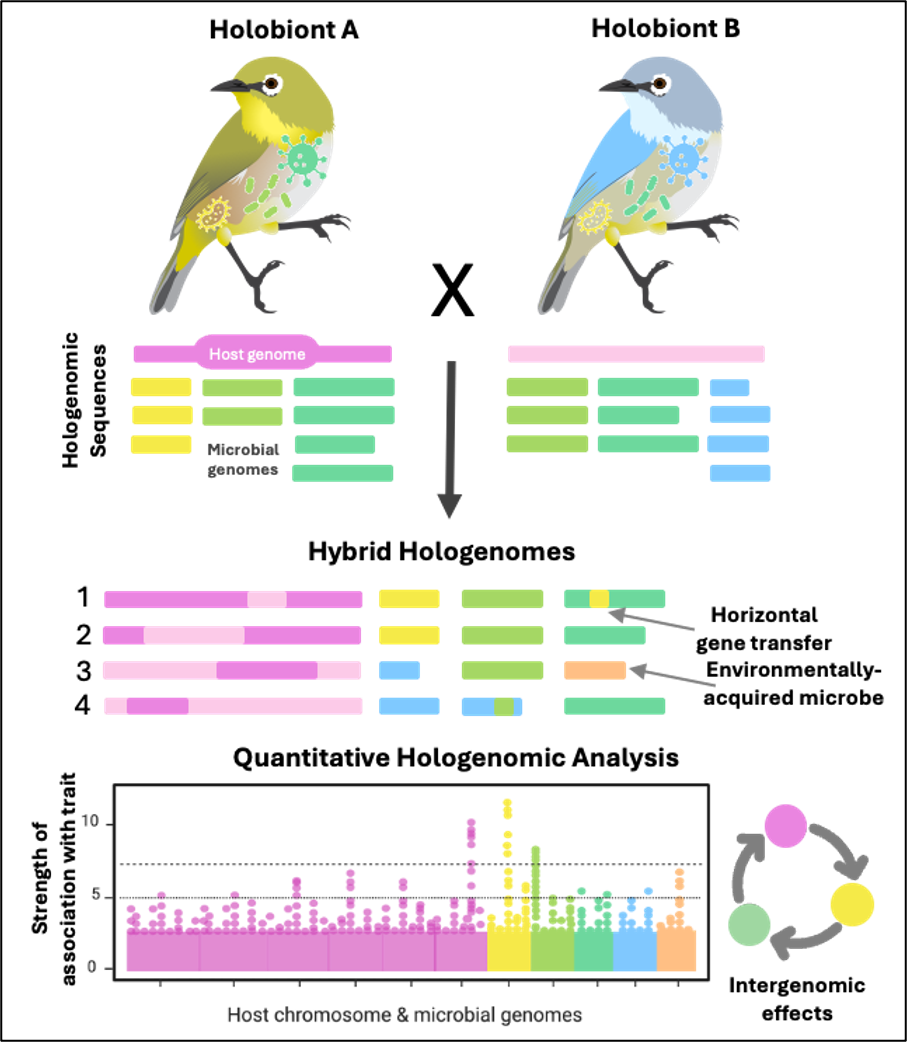
Figure 1: Quantitative hologenomics explores phenotypic traits shaped by both host and microbial genes, unlike traditional quantitative genetics focused on single-species variation. Trait variation can arise via vertical inheritance, environmental microbial acquisition, and horizontal gene transfer in the microbiome (Figure credit: Drs. Nichole Ginnan and Seth Bordenstein, Pennsylvania State University, One Health Microbiome Center).
The full study is available on the Science website.