

Electrical and Communication Engineering Department
Electrical and Communication Engineering Department
Overview
The Department of Electrical and Communication Engineering at the United Arab Emirates University offers a comprehensive range of undergraduate and graduate programs that prepare students for successful careers in engineering, technology, research, and innovation.
Electrical engineering is a broad and rapidly evolving discipline encompassing major areas such as electric power and energy systems, control and automation, electronics, computer engineering, communications and signal processing, and electromagnetics. The Department's academic programs are designed to provide students with strong foundations in these areas while offering opportunities for specialization and advanced study.
At the undergraduate level, the Department offers two programs: Electrical Engineering and Communication Engineering. The Electrical Engineering program provides broad-based education integrating power and energy systems, control and automation, electronics, computer engineering, and communications and signal processing. The Communication Engineering program provides a more specialized education with particular emphasis on communication systems, wireless technologies, and electromagnetics.
Both undergraduate programs are accredited by the Engineering Accreditation Commission of ABET, reflecting their commitment to internationally recognized standards of engineering education.Engineering Accreditation Commission of ABET.
Students benefit from state-of-the-art laboratories that complement classroom learning through practical, hands-on experience. Laboratory activities enable students to apply theoretical concepts, develop engineering and problem-solving skills, and gain experience with technologies and tools relevant to professional engineering practice.
Experiential learning is further strengthened through a full-semester internship, during which undergraduate students gain professional experience in governmental organizations or private-sector companies in the UAE or abroad. This experience helps students connect their academic preparation with real-world engineering practice and prepares them for the transition to their professional careers.
The undergraduate programs are designed to equip graduates with the knowledge, technical skills, and professional competencies needed to enter the engineering profession or pursue advanced graduate studies.
At the graduate level, the Department offers Master of Science (MSc) and Doctor of Philosophy (PhD) programs in Electrical Engineering. These programs provide advanced education and research opportunities across a wide range of electrical engineering disciplines and prepare highly skilled engineers, researchers, and future leaders in academia and industry.
Research is an integral part of the Department's mission. Faculty members are actively engaged in research across areas including power and energy systems, renewable energy, power electronics, control and automation, electronics and microelectronics, computer engineering, communications and signal processing, electromagnetics, nanotechnology, autonomous and unmanned systems, and related emerging technologies. Through their research, teaching, and collaboration with industry and other institutions, faculty members contribute to technological advancement and to addressing engineering challenges of importance to the UAE and the wider international community
Mission
The mission of the Department of Electrical and Communication Engineering is to provide high-quality education, advance knowledge through impactful research and innovation, and serve the needs of the UAE and the wider community. The Department is committed to preparing highly qualified engineers and researchers with the knowledge, skills, creativity, and professional values needed to address current and emerging engineering challenges and contribute to technological, economic, and sustainable development.
Goals
- Provide high-quality undergraduate and graduate education that meets internationally recognized standards of academic excellence.
- Maintain modern and forward-looking curricula that respond to advances in electrical and communication engineering, emerging technologies, and the evolving needs of industry and society.
- Foster a student-centered learning environment that supports academic success, professional development, innovation, entrepreneurship, and lifelong learning.
- Recruit, develop, and retain highly qualified faculty members who demonstrate excellence in teaching, research, and service.
- Strengthen graduate education and promote high-quality, impactful research and scholarly activities across the Department's areas of expertise.
- Promote interdisciplinary research, innovation, and collaboration that address strategic priorities and technological challenges of relevance to the UAE and the global community.
- Strengthen partnerships and engagement with industry, government, professional organizations, alumni, and the wider community.
- Provide an effective, responsive, transparent, and accountable academic and administrative environment that supports the Department's educational and research missions.
- Maintain and continuously enhance state-of-the-art laboratories, research infrastructure, and learning facilities.
- Expand opportunities for external research funding, industry-supported initiatives, and other partnerships that contribute to the long-term development and sustainability of the Department.
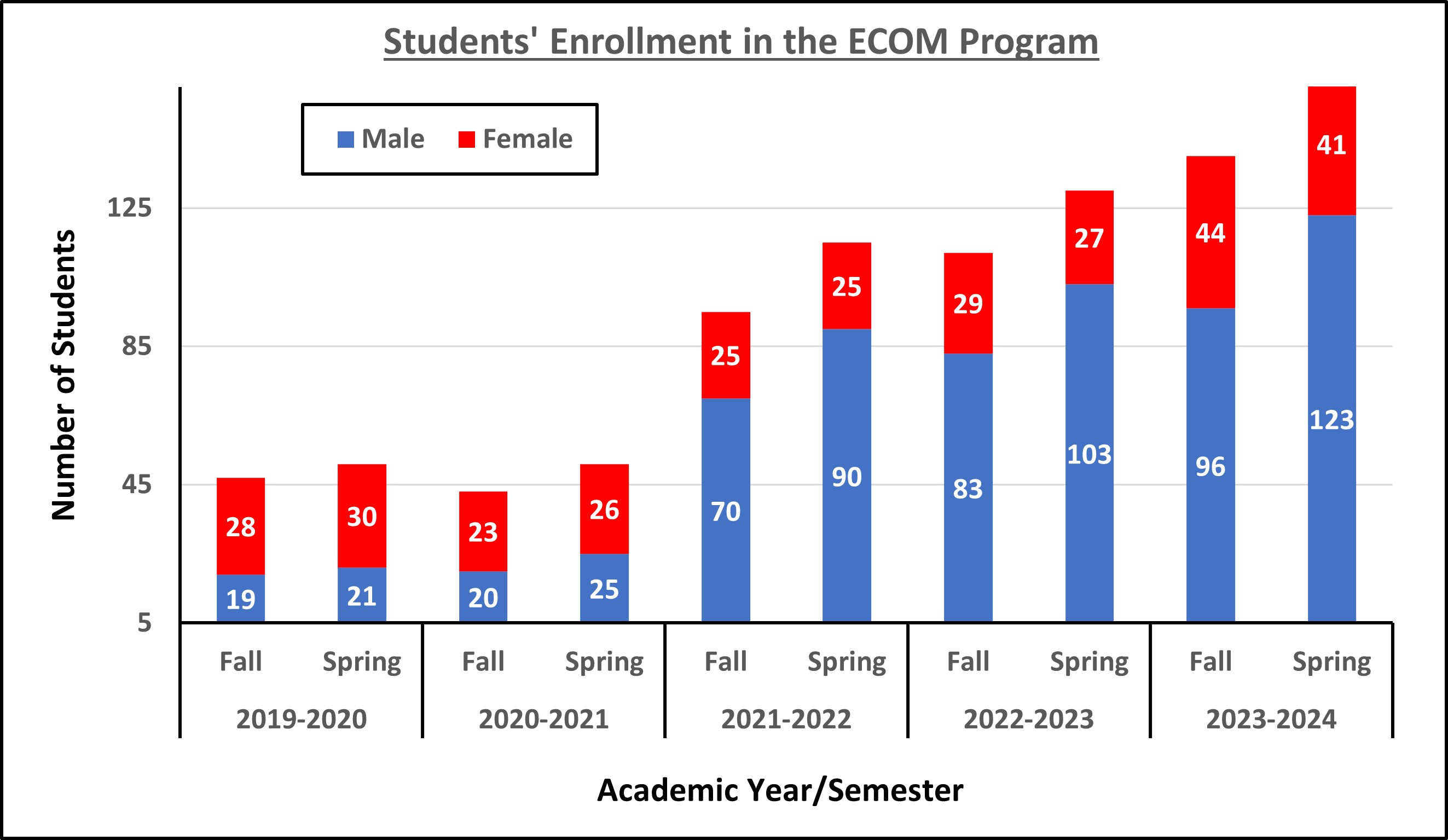
Students' Enrollment in the ECOM Program
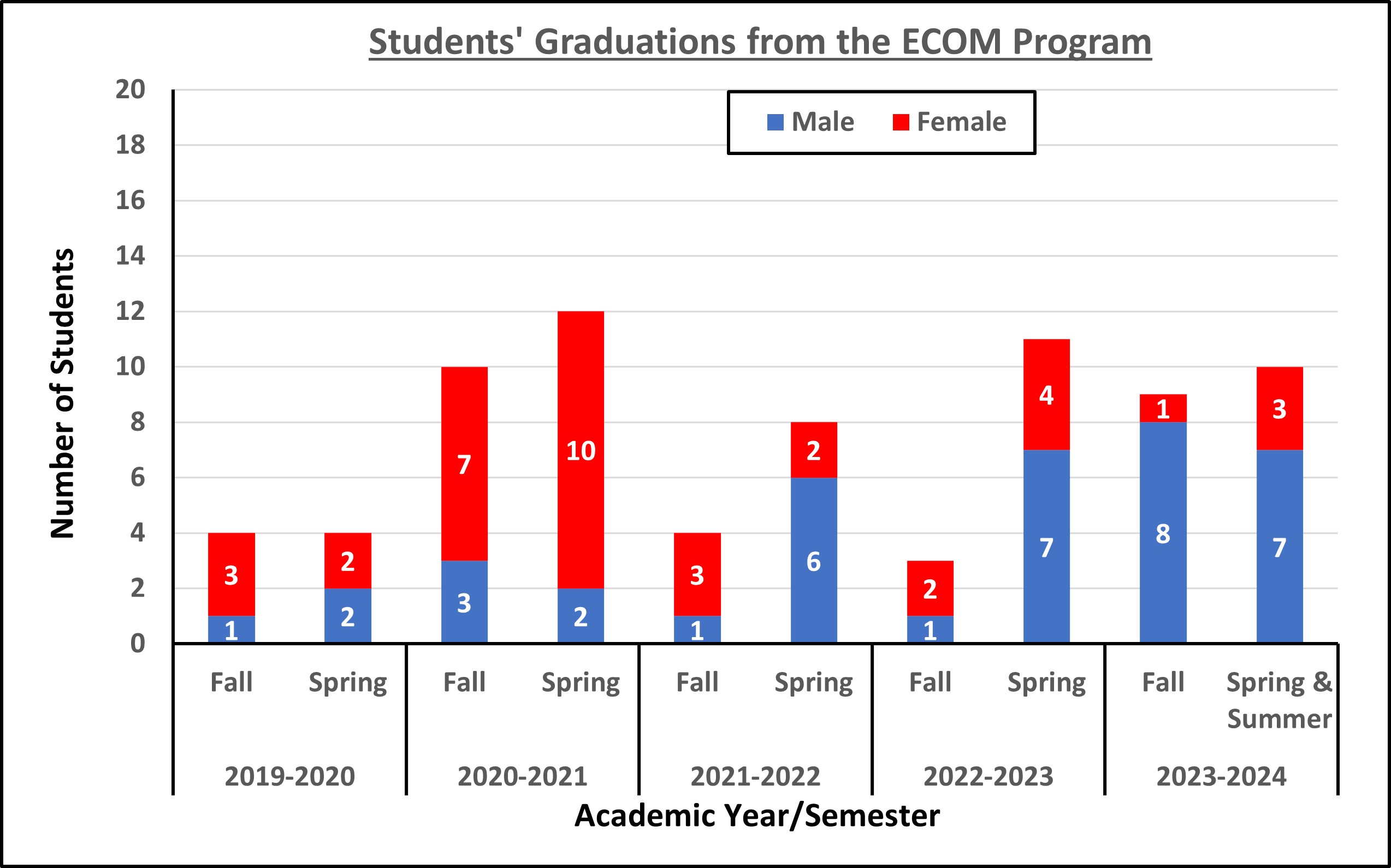
Students' Graduations from the ECOM Program
Enrolment and Graduation Data
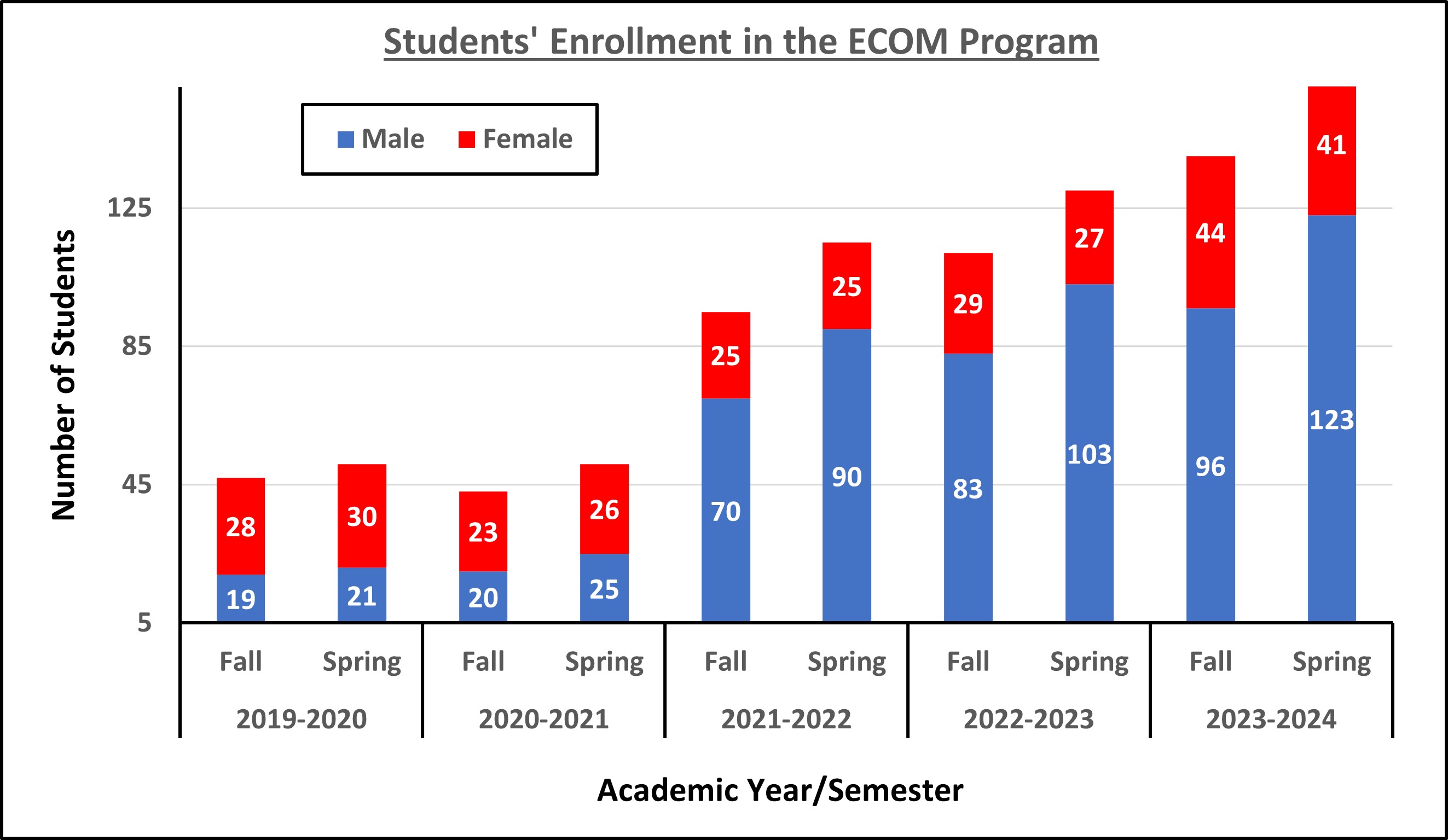
Students' Enrollment in the EE Program
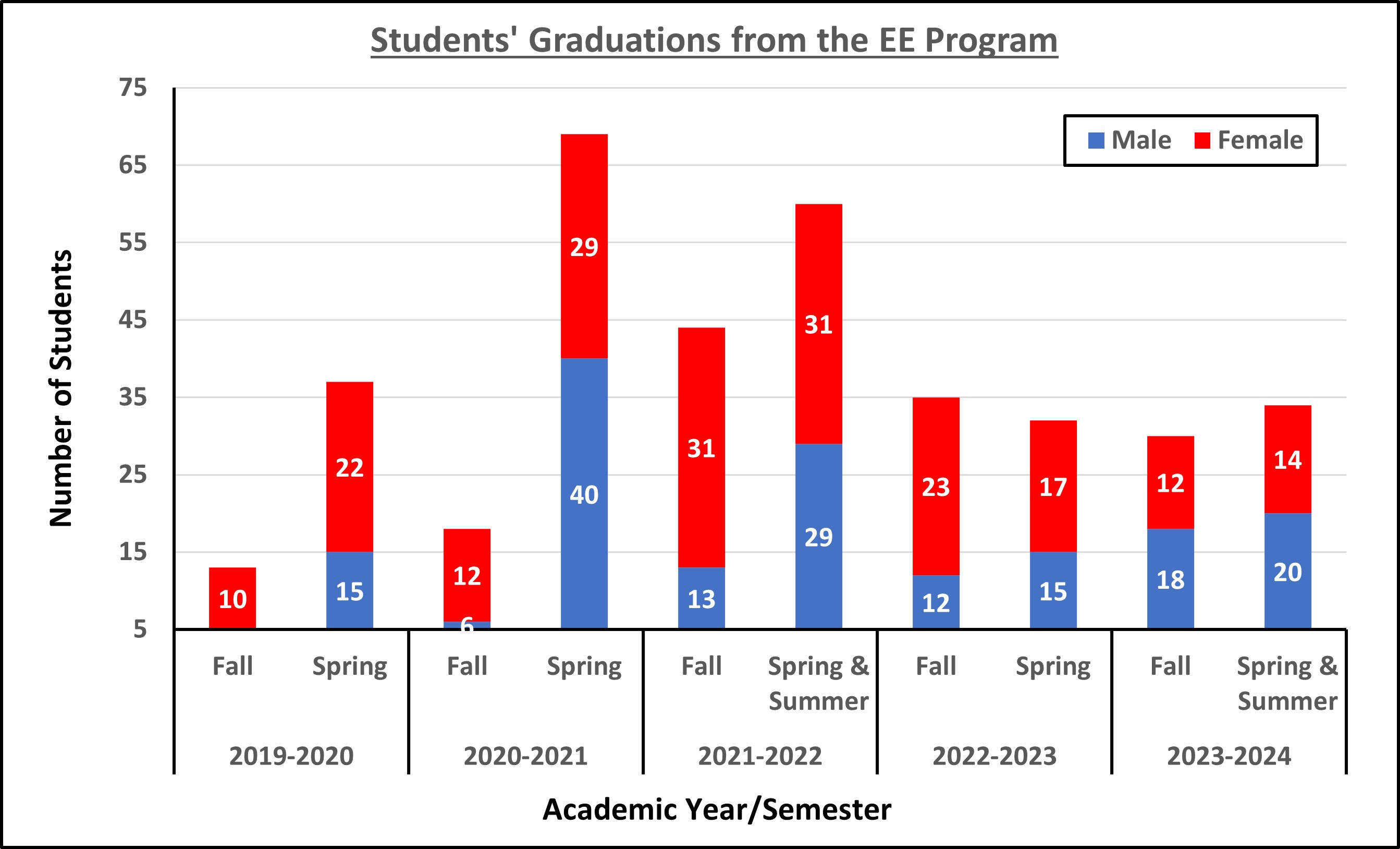
Students' Graduations from the EE Program
Laboratories
Laboratories
The EE Laboratories are mainly used for undergraduate courses. They are of considerable
importance in fulfilling different course objectives. They tie up the theoretical
and practical aspects. Besides, they also serve faculty and student research needs
with newly acquired equipment and software.
1. Circuits and Electronics Lab
The Circuits and Electronics Laboratories are located in E6 building. These are among the best-equipped laboratories in the College of Engineering, and have gone recently through several renovations and upgrades. These laboratories provide hands-on experience and services to the laboratory courses of Electric Circuits Lab, Digital Logic Design Lab, and Electronic Circuits Lab including the design and implementation of solid-state analog and digital electronic circuits. The laboratories are equipped with function generators having a frequency range that extends up to 125 MHz, multifunction oscilloscopes (provide bandwidth & sampling rate), programmable power supplies and multi-meters, all equipped with GPIB communication and control capabilities. Other specialized equipment s in the Circuits and Electronics Laboratory include amplifiers with a gain up to 60 dB and a frequency range from DC to 100 MHz, LCR meters, differential amplifiers, phase shifters, converters, analog/digital IC testers, breadboards, and a variety of training kits. The department has recently acquired more advanced electronics equipment that can be used in student projects and faculty research such as pulse generator, automatic calibration system, 1 GHz mixed-signal oscilloscope, and a LPFK PCB manufacturing system.
2. Communications and Microprocessors Lab
This laboratory is equipped with state of the art equipment that can be used to serve the laboratory courses of Communication Systems Lab, Digital Signal Processing Lab, Data Communication & Networks Lab, Microprocessors Lab as well as supporting advanced courses with Lab content such as Electromagnetic Waves, Antenna Engineering, Communication Circuits, and Wireless Communications.
The lab is equipped with analogue and digital communication kits, measuring instruments, signal generators and analyzers for undergraduate courses, spectrum analyzers, vector network analyzer, Impedance Analyzer, microwave communication kits, antenna kits, and other high frequency instrumentation.
3. Computer Lab
This laboratory is equipped with the latest and up-to-date high performance DELL computers to service the computer programming-related courses and for general use by EE students and faculty.
The lab includes high-level language programming and Assembly language programming as well as numerous software packages for student and faculty use.
4. Control and Industrial Automation Lab
The objective of this laboratory is to illustrate the topics taught in Control Systems and Industrial Automation courses. It serves to train students on the design, the setup, and the analysis of controllers. The aim is to cover a wide range of controlled variables (Temperature, Level, Flow, Pressure, Position, Speed, etc.) and controller devices used in industry (Industrial controllers, PLCs, Data Acquisition boards associated with a computer).
This laboratory allows students to get familiar with complete methodologies to design a PID controller including: modeling, validation, simulation, implementation of the controller, and testing. The experimental setups used for this purpose are: a crane for position control (built by students during their graduation project), a training system for temperature control, a system for pressure control and air flow control, a hydraulic system for water flow control, a magnetic levitation system, and a two-tank system for level and flow control (built by the lab. Engineer and the students). The software packages used in this laboratory are: Matlab/Simulink and Labview.
Discrete event systems are also studied using PLCs. For this purpose, a sorting system, a bottling system, an elevator, and an automatic door are used. The objective is to teach students how to program a PLC. Two types of PLCs (Siemens and Mitsubishi) are used.
In addition to the scheduled lab. courses, the experiments are used by senior students for their graduation projects and by graduate students.
5. Electrical Machines Lab
Electrical Machines Laboratory is of considerable assistance in fulfilling the objectives of teaching the Electrical Energy Conversion course in the Electrical and Communication Engineering Department. The laboratory is well equipped with necessary experiments that can be easily performed to strengthen the correlation between theory and practical aspects. The laboratory has one teaching transformer unit consists of a three single-phase with 1KVA rating each. Terminals of these transformers are accessible to connect single-phase, autotransformer, three-phase as star, delta ……etc. connections for laboratory exercises. The laboratory also has numbers of DC motors and generators, all common arrangements such as series, parallel and compound machines are readily available at connecting plate of each machine. Synchronous machines are also provided to examine the behavior of the machines with different type of loads. Induction motors wildly used as slip ring and squirrel cage are also provided for studying the characteristic of the motors with and without loads. The laboratory also has frequency drive training unit including small three-phase induction motor and variable mechanical load to study the characteristics of the inverter. Feedback control system are also available, contains servo motors, servo motor controller and tacho-generator. Variable ac and dc electrical sources are supplied to the laboratory to facilitate the practical experiments. Many instruments are available to measure speed, torque, harmonics, load power, power factor, voltage and current. All this make electrical machines and power lab quit suitable for education and can be adopted for use in some research work.
6. Power System Lab
The objective of this laboratory is to allow integration and application of real-time monitoring, advanced sensing, communications, dynamic flow of both energy and information to accommodate existing and new forms of supply, delivery and use in a secure, reliable and efficient electric power system from generation source to end-user. Besides the knowledge of power systems, this lab supports education in several power system related areas such as communications, controls, electronics, instrumentation, computers and IT. This multidisciplinary and integrative nature facilitate the learning process and develop experiments with physical integrated solutions that allow future smart grid designers and operators to gain knowledge at different levels as revealed in Bloom's Taxonomy.
7. High Frequency Lab
The High Frequency Laboratory is located in the ground floor of E6 building. It is equipped with all basic RF equipment like; Vector Network Analyzer (VNA) - ZVL6 Rohde & Schwarz (9KHz 6GHz), Vector Network Analyzer (VNA) - ZVL13 Rohde & Schwarz (9KHz 13.6GHz), Spectrum Analyzer - FHS8 Rohde & Schwarz (9KHz 8GHz), RF Vector Signal Generator Model: 2920 Keithley (10MHz 6GHz),Output Power range: (-125dBm up to +13dBm), and LCR Meter Model: TEGAM3350 (42Hz -5MHz). In conjunction with a workshop, which is equipped with precision PCB milling machines, this laboratory provides a complete solution to manufacture and measure the RF and Microwave PCBs in this lab. The High Frequency Laboratory supports Electrical Engineering courses such as ECOM 412, ECOM 531, ECOM 532, ECOM542, ECOM 571, ECOM 580, ELEC 325, ELEC 570, and Graduation Project Courses. This laboratory is also used to support research activities.
8. Workshop1
Workshop 1 is designed and built for hand soldering of electronic components. It includes about ten soldering stations. Each soldering stations includes temperature controlled hot-air gun and a temperature controlled soldering iron. The workshop provides students with all necessary soldering items such as soldering wick, paste, de-soldering pump, solder, soldering iron tip cleaner, etc. The workshop supports Electrical Engineering courses such ELEC 375, ELEC 570, ELEC 562 and Graduation Project Courses. The lab engineers also use the workshop to support research activities.
9. Workshop2
Workshop 2 is equipped with PCB prototype milling machine that supports double sided PCBs up to about 20cm x 25cm boards. The milling machine is attached to a desktop computer with CAD software to support the design and production of PCBs. Workshop 2 is also equipped with a semi-automatic pick and place machine that supports surface mount devices (SMDs). A lead-free reflow oven and a hot air oven are available for support of soldering SMDs using leaded and lead-free solder.
Academic Programs
Publications
Please click here to view the Google Scholar Profile for the College of Engineering. Please note that the publications listed on Google Scholar are categorized by faculty and not by their current place of employment. Therefore, some publications listed on this website may not have been done whilst the faculty member was employed at the United Arab Emirates University.
To view the list of conference paper,published books, and Patents presented by the Electrical Engineering Department please click on each year below:
2009 | 2010 | 2011 | 2012 | 2013 | 2014 | 2016 | 2017 | 2018 | 2019 | 2020 | 2021 | 2022 | 2023
Faculty
Note: If calling from outside the UAEU organization, dial (+971 3 713) before the extension.
| Name | Position | Ext. | |
|---|---|---|---|
| Dr. Hamad AlKhoori |
Associate Professor, Dept. Chair |
hamad.alkhoori@uaeu.ac.ae |
5186 |
|
Professor |
|
||
|
Professor |
5149 |
||
|
Professor |
5564 |
||
|
Professor |
5390 |
||
|
Professor |
5150 |
||
|
Professor |
5140 |
||
|
Associate Professor |
5536 |
||
|
Associate Professor |
5151 |
||
|
Associate Professor |
6575 |
||
|
Associate Professor |
5148 |
||
|
Associate Professor |
5185 |
||
|
Associate Professor |
5143 |
||
| Dr. Nabil Bastaki |
Associate Professor |
nabil@uaeu.ac.ae |
5147 |
| Dr. Nasir Saeed |
Associate Professor |
nasir.saeed@uaeu.ac.ae |
6492 |
|
Associate Professor |
|
||
|
Associate Professor |
5144 |
||
|
Associate Professor |
5389 |
||
|
Associate Professor |
5330 |
||
|
Assistant Professor |
5121 |
||
| Dr. Dalia Arafa Rashed |
Assistant Professor |
dalia.ayousri@uaeu.ac.ae |
5697 |
|
Assistant Professor |
5146 |
||
|
Instructor |
4751 |
||
|
Instructor |
5336 |
||
|
Instructor |
5199 |
Staff
Name
Position
Email
Ext.
Eng. Abdulrahman Daher
Lab Specialist
abd.daher@uaeu.ac.ae
6254
Eng. Ahmed Abd-Rabou
Lab Specialist
aabdrabou@uaeu.ac.ae
6635
Eng. Fadia Ali Mohamed
Lab Specialist
f.mohamed@uaeu.ac.ae
6645
Eng. Mutaz Mohamed khairalla
Lab Specialist
mkhairalla@uaeu.ac.ae
6643
Shamma Al Falahi
Secretary
shamma.g@uaeu.ac.ae
5152
General Enquiries
Thank you for your interest in the Electrical and Communication Engineering. We welcome your query and encourage you to contact us using the information below:
United Arab Emirates University,
College of Engineering,
P.O.Box: 15551, Al Ain, UAE
Phone: +971 3 713 5152
Fax: +971 3 713 4970
Email: ee.eng@uaeu.ac.ae