

Insect Farming on Food and Plant Waste
Objectives
- To develop technologies for economically and environmentally feasible integration of insect farming into organic waste recycling paths of the Gulf Region
- To assess prospects and risks pertaining to the use of insects as feed for animals and food for humans.
- To further expand and provide facilities for research and training on farming of black soldier flies\
Group Members
- Dr. Elke Neumann, Group Leader / PI
- Fatima Saeed Al Nuaimi, Master Student
- Fatima Eltelib Hassan, Ph.D Student
- Felix Guiabar Labata, Animal Nutrition Lab Specialist
- Ahmad Abdulla Ali, Research Assistant
- Ms. Afra Al Ameri, Aquaculture lab Specialist
Insects can convert organic waste materials into protein-rich biomass at a very high use efficiency for energy and water. Insect residues (frass) are a valuable organic fertilizer for plants.
The culture of black soldier flies (Hermetia illucens) on organic waste materials yields insect protein that can be used to feed poultry and farmed fish. Other insects, such as the buffalo worm (Alphitobius diaperinus), also have a potential to serve in the production of human food.
The domestication of insects for food production in the Gulf Region is still a very young industry, and a lot of research is needed to make sure that production systems are efficient and safe in an environmental and public health context.
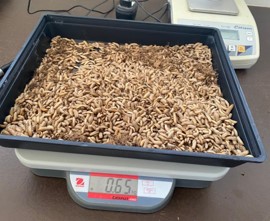
Insect biomass is a sustainable source of protein for farmed fish and poultry
The black soldier fly is one of the most widely farmed insects. Its larvae grow particularly well on food waste or manure, but in the UAE and many other countries there are restrictions regarding the use of such materials as a feed for animals. For this reason, we test how other waste materials, such as crop residues, could be converted into a palatable feed for the black soldier flies, e.g. by grinding, boiling, extracting, and/or fermenting them.
Our group also develops backyard-size farming modules that can be used at the household level for waste recycling via insect farming and aquaponics.
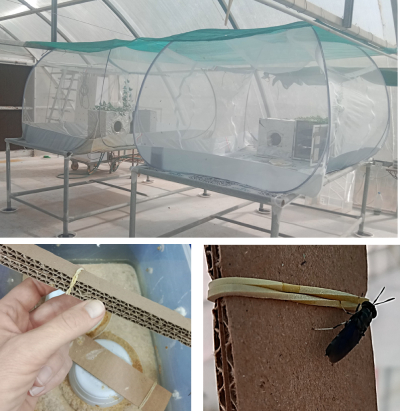
In a mating cage (top) the black soldier flies lay their eggs in pieces of cardboard. These are then used to start new production cycles (bottom).
We collaborate with
- The growth substrates group to test how insect frass can become a safe and sustainable component of horticultural growth substrates
- The mushroom farming group to develop strategies for integration of mushroom and insect farming
- The antimicrobial residues group to test antimicrobial residues and resistances in insects farmed on waste materials.
Do you find this content helpful?
عفوا
لايوجد محتوى عربي لهذه الصفحة
عفوا
يوجد مشكلة في الصفحة التي تحاول الوصول إليها