

Microalgae for Feed and Food Production
Objectives
The team aims to isolate and cultivate scale-able microalgal strains including those that are salt- and heat-tolerant microalgae. These would be isolated from the terrestrial and aquatic environments of Abu Dhabi, UAE for food and feed applications, with a specific focus on aquafeed. This sub-theme will also explore to formulate UAE wastewater as media for microalgae growth to reduce dependency on commercial media. This project aligns with circular bioeconomy principles and UN Sustainable Development Goals, promoting sustainability, responsible production, and marine life conservation. Our theme is expected to offer resource-efficient value chains, providing nutritious diets and ecosystem services to the aquaculture industry and society.
Group Member
- Prof. Syed Salman Ashraf, Subtheme PI
- Dr. Ashfaq Ahmad, Post Doctoral Research Scientist
We have established ARIFSID’s Microalgae Culture Laboratory at Khalifa University,
Main Campus (Biological Sciences Department, 3rd Floor, B03002 Lab) dedicated to cultivating
a wide range of freshwater and marine microalgal strains. These strains have been
carefully selected for their suitability in aquafeed production and industrial wastewater
treatment. We have successfully isolated heat and salt-tolerant microalgal strains
from the Eastern Mangroves of Abu Dhabi. These strains exhibit high levels of proteins,
carbohydrates, and lipids. They hold significant potential for various applications,
including aquafeed, bioremediation, and biofuel production. Our main focus is to optimize
microalgal strains for their growth conditions and to enhance their biochemical composition
and their nutrient value so that they can serve as a nutritious and sustainable feed
source for the aquaculture industry. 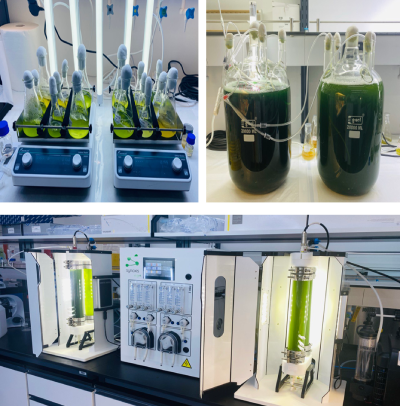
Microalgae culture selection (top left) is followed by mass production of the most promising strains in bioreactors (top right and bottom).
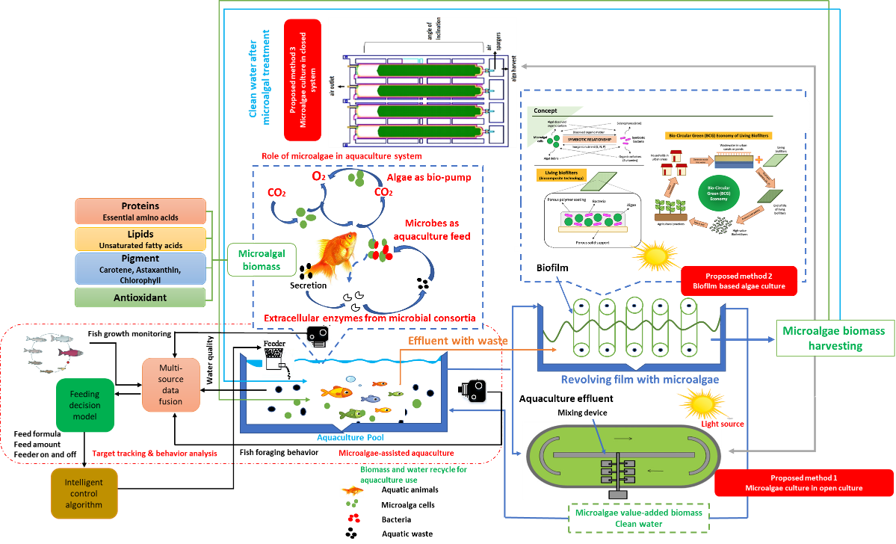
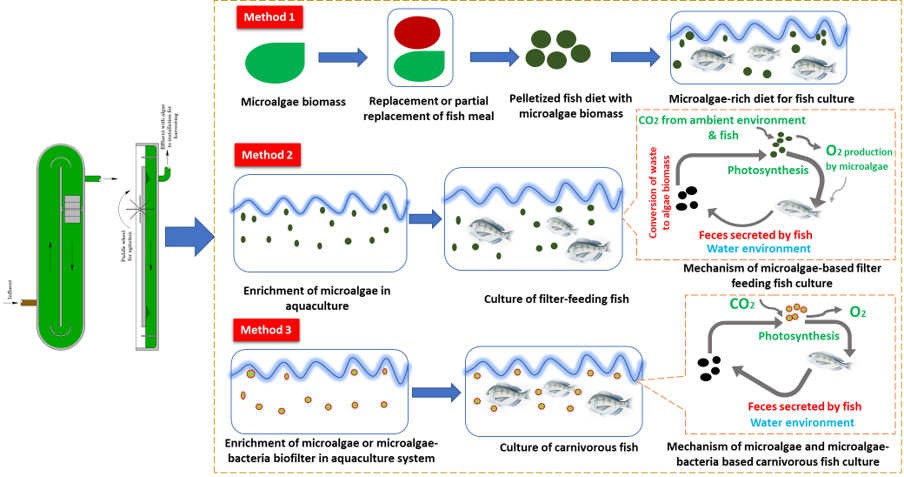
This subtheme focuses on the development of living biofilters (bio-composites technology) based on microalgae to efficiently recover nutrients from aquaculture and wastewater. These biofilters will explore the use of different types of environmentally friendly polymers (e.g. alginate) to immobilize/encapsulate microalgae and reduce reliance on energy-intensive biomass harvesting processes. The resulting pellets can serve as sustainable aquafeed and biofertilizers that can enhance crop yield and productivity.
Do you find this content helpful?
عفوا
لايوجد محتوى عربي لهذه الصفحة
عفوا
يوجد مشكلة في الصفحة التي تحاول الوصول إليها