

The growing city - Integration of food production into urban living environments
Objectives
- Studying the integration of food systems into cities.
- Identifying appropriate planning and urban development strategies that ensure sustainable and secure food provision.
- Identifying urban planning solutions that complement food policy and food security frameworks.
- Identifying appropriate urban agriculture models to be implemented in neighborhoods and urban centers.
Group members
- Dr. Khaled Alawadi, Group Leader/ PI
- Nour Alkhaja, Research Associate
- Rim Alnabtawim, Research Assistant
ARIFSID established and operates the first Urban Agriculture Laboratory in the United
Arab Emirates, located at Khalifa University's main campus. The laboratory is comprised of a diverse team of
over 10 members, including professors, research scientists, Masters and PhD students. This initiative positions us at the
forefront of urban agricultural innovation and research, not just within the nation, but on a global scale. This state-of-the-art
facility is dedicated to investigating and promoting sustainable urban farming practices. Our mission is to redefine urban landscapes
by integrating agricultural production in cities, not only to meet food security challenges but also to promote
more sustainable community growth. 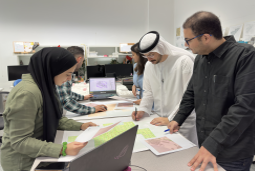
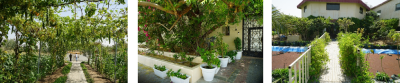
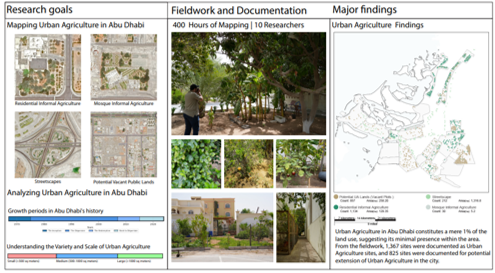
We perform a comprehensive analysis of urban agriculture in Abu Dhabi, involving the following:
- Conducting urban land inventory mapping and analysis. This step enables the identification of possible land-parcels that can accommodate cultivational activities within the city center and the residential neighborhoods .
- Conducting food asset mapping at multiple levels (neighborhoods, municipal, or metropolitan). Such mapping would help measuring community access to food
- Conducting land-suitability analysis. This would enable the identification of suitable land parcels, from the land inventory, with regard to multiple criteria, in terms of soil, irrigation availability, neighborhood accessibility and service accessibility. Match the urban agriculture production capacity and potential with the projected population growth, and the current population density within residential neighborhoods.
- Recommending the appropriate urban planning and design guidelines (Zoning, Land-use, Accessibility) to integrate urban agriculture within the city, while considering issues of sustainability and community involvement.
- Recommend urban planning policy and future development guidelines to ensure that future planned neighborhoods have integrated cultivation locations within them.
- Identifying successful implementation strategies, with regard to different farming types farming(horticulture, vertical farming, etc.).
Do you find this content helpful?
عفوا
لايوجد محتوى عربي لهذه الصفحة
عفوا
يوجد مشكلة في الصفحة التي تحاول الوصول إليها