

Books
Assessment and Teaching of 21st Century Skills
- By : Batrick Griffin,Barry McGaw, Esther Care
 Pub lished by: Springer, 2012
- ISBN: 9789400723245
Description:
Provides operational definitions of 21st century skills. Solution-focussed approaches to methodological constraints and technological barriers to the assessment of 21st century skills. Contains descriptions of example assessment tasks. Offers international perspectives and comparisons of assessment approaches and assessment policy. Supported by major companies and leading institutes such as CISCO, Intel and Microsoft as well as the World Bank, UNESCO, and OECD.
Developing Outcomes-Based Assessment for Learner-Centered Education: A Faculty Introduction
- By: Amy Driscoll
- Published by: Stylus Publishing; Illustrated edition (2007)
- ISBN : 9781579221959
Description:
 The authors--a once-skeptical chemistry professor and a director of assessment sensitive
to the concerns of her teacher colleagues--use a personal voice to describe the basics
of outcomes-based assessment.
The authors--a once-skeptical chemistry professor and a director of assessment sensitive
to the concerns of her teacher colleagues--use a personal voice to describe the basics
of outcomes-based assessment.
The purpose of the book is to empower faculty to develop and maintain ownership of assessment by articulating the learning outcomes and evidence of learning that are appropriate for their courses and programs.
The authors offer readers a guide to the not always tidy process of articulating expectations, defining criteria and standards, and aligning course content consistently with desired outcomes. The wealth of examples and stories, including accounts of successes and false starts, provide a realistic and honest guide to what's involved in the institutionalization of assessment.
Revisiting outcomes assessment in higher education
- By: Peter Hernon, Robert E Dugan, Candy Schwartz
- Published by: Westport, Conn. : Libraries Unlimited, 2006
- ISBN: 9781591582762
Description:
 Revisiting Outcomes Assessment in Higher Education compliments rather than updates
Hernon and Dugan's 2004 Outcomes Assessment in Higher Education. As with its predecessor,
it offers a cross-campus diversity of voices: contributors hail from various segments
of higher organizations, an academic vice president, academic deans, a higher education
consultant, faculty members, and librarians. Individually, they shed light on how
their corner of the higher education universe views, facilitates, and substantiates outcomes assessment.
Together, they document what is known about outcomes assessment in the middle of the
first decade of the new century, as institutions and their programs take ever-firmer
steps from anecdotal evidence to more rigorous diagnosis and reporting.
Revisiting Outcomes Assessment in Higher Education compliments rather than updates
Hernon and Dugan's 2004 Outcomes Assessment in Higher Education. As with its predecessor,
it offers a cross-campus diversity of voices: contributors hail from various segments
of higher organizations, an academic vice president, academic deans, a higher education
consultant, faculty members, and librarians. Individually, they shed light on how
their corner of the higher education universe views, facilitates, and substantiates outcomes assessment.
Together, they document what is known about outcomes assessment in the middle of the
first decade of the new century, as institutions and their programs take ever-firmer
steps from anecdotal evidence to more rigorous diagnosis and reporting.
Learning Assessment Techniques
- By Elizabeth F. Barkley
- Published by: Jossey-Bass, January 2016
- ISBN: 9781119050896
Description:
 50 Techniques for Engaging Students and Assessing Learning in College Courses Do you
want to: Know what and how well your students are learning? Promote active learning
in ways that readily integrate assessment? Gather information that can help make grading
more systematic and streamlined? Efficiently collect solid learning outcomes data
for institutional assessment? Provide evidence of your teaching effectiveness for
promotion and tenure review? Learning Assessment Techniques provides 50 easy-to-implement
active learning techniques that gauge student learning across academic disciplines
and learning environments. Using Fink's Taxonomy of Significant Learning as its organizational
framework, it embeds assessment within active learning activities. Each technique
features: purpose and use, key learning goals, step-by-step implementation, online
adaptation, analysis and reporting, concrete examples in both on-site and online environments,
and key references--all in an easy-to-follow format. The book includes an all-new
Learning Goals Inventory, as well as more than 35 customizable assessment rubrics,
to help teachers determine significant learning goals and appropriate techniques.
This book also provides access to a downloadable worksheet to guide teachers through
the seven steps of the Learning Assessment Techniques planning and implementation
cycle. College teachers today are under increased pressure to teach effectively and
provide evidence of what, and how well, students are learning. An invaluable asset
for college teachers of any subject, Learning Assessment Techniques provides a practical
framework for seamlessly integrating teaching, learning, and assessment.
50 Techniques for Engaging Students and Assessing Learning in College Courses Do you
want to: Know what and how well your students are learning? Promote active learning
in ways that readily integrate assessment? Gather information that can help make grading
more systematic and streamlined? Efficiently collect solid learning outcomes data
for institutional assessment? Provide evidence of your teaching effectiveness for
promotion and tenure review? Learning Assessment Techniques provides 50 easy-to-implement
active learning techniques that gauge student learning across academic disciplines
and learning environments. Using Fink's Taxonomy of Significant Learning as its organizational
framework, it embeds assessment within active learning activities. Each technique
features: purpose and use, key learning goals, step-by-step implementation, online
adaptation, analysis and reporting, concrete examples in both on-site and online environments,
and key references--all in an easy-to-follow format. The book includes an all-new
Learning Goals Inventory, as well as more than 35 customizable assessment rubrics,
to help teachers determine significant learning goals and appropriate techniques.
This book also provides access to a downloadable worksheet to guide teachers through
the seven steps of the Learning Assessment Techniques planning and implementation
cycle. College teachers today are under increased pressure to teach effectively and
provide evidence of what, and how well, students are learning. An invaluable asset
for college teachers of any subject, Learning Assessment Techniques provides a practical
framework for seamlessly integrating teaching, learning, and assessment.
Assessing Student Learning: A Common Sense Guide
- By: Linda Suskie
- Published by: Jossey-Bass, February 2018, 3rd Edition
- ISBN: 9781119426936
Description:
 Assessing Student Learning is a standard reference for college faculty and administrators,
and the third edition of this highly regarded book continues to offer comprehensive,
practical, plainspoken guidance. The third edition adds a stronger emphasis on making
assessment useful; greater attention to building a culture in which assessment is
used to inform important decisions; an enhanced focus on the many settings of assessment,
especially general education and co-curricula; a new emphasis on synthesizing evidence
of student learning into an overall picture of an integrated learning experience;
new chapters on curriculum design and assessing the hard-to-assess; more thorough
information on organizing assessment processes; new frameworks for rubric design and
setting standards and targets; and many new resources. Faculty, administrators, new
and experienced assessment practitioners, and students in graduate courses on higher
education assessment will all find this a valuable addition to their bookshelves.
Assessing Student Learning is a standard reference for college faculty and administrators,
and the third edition of this highly regarded book continues to offer comprehensive,
practical, plainspoken guidance. The third edition adds a stronger emphasis on making
assessment useful; greater attention to building a culture in which assessment is
used to inform important decisions; an enhanced focus on the many settings of assessment,
especially general education and co-curricula; a new emphasis on synthesizing evidence
of student learning into an overall picture of an integrated learning experience;
new chapters on curriculum design and assessing the hard-to-assess; more thorough
information on organizing assessment processes; new frameworks for rubric design and
setting standards and targets; and many new resources. Faculty, administrators, new
and experienced assessment practitioners, and students in graduate courses on higher
education assessment will all find this a valuable addition to their bookshelves.
- Assessment Clear and Simple
- By: Barbara E. Walvoord
- Published by: Jossey-Bass, April 12, 2010
- ISBN: 9780470593301
Description:
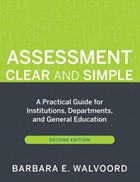 The first edition of Assessment Clear and Simple quickly became the essential go-to
guide for anyone who participates in the assessment process in higher education. With
the increased pressure to perform assessment to demonstrate accountability, Assessment
Clear and Simple is needed more than ever. This second edition of the classic resource
offers a concise, step-by-step guide that helps make assessment simple, cost-efficient,
and useful to an institution. It contains effective strategies for meeting the requirements
of accreditation agencies, legislatures, review boards, and others, while emphasizing
and showing how to move from data to actions that improve student learning. This thoroughly
revised and updated edition includes many new or expanded features, including:
The first edition of Assessment Clear and Simple quickly became the essential go-to
guide for anyone who participates in the assessment process in higher education. With
the increased pressure to perform assessment to demonstrate accountability, Assessment
Clear and Simple is needed more than ever. This second edition of the classic resource
offers a concise, step-by-step guide that helps make assessment simple, cost-efficient,
and useful to an institution. It contains effective strategies for meeting the requirements
of accreditation agencies, legislatures, review boards, and others, while emphasizing
and showing how to move from data to actions that improve student learning. This thoroughly
revised and updated edition includes many new or expanded features, including:
- Illustrative examples drawn from the author's experience consulting with more than 350 institutions
- A basic, no-frills assessment plan for departments and for general education
- Tips on how to integrate portfolios and e-portfolios into the assessment process
- Suggestions for using rubrics and alternatives to rubrics, including doing assessment for multidisciplinary work
- Clear instructions on how to construct a coherent institution-wide assessment system and explain it to accreditors
- Ideas for assigning responsibility for general education assessment
- Strategies for gathering information about departmental assessment while keeping the departmental workload manageable
- Information on how to manage assessment in times of budgetary cutbacks
- Designing and Assessing Courses and Curricula: A Practical Guide
- By: Robert M. Diamond
- Published by: Jossey-Bass, August 2008, 3rd Edition
- ISBN: 9780470261347
Description:
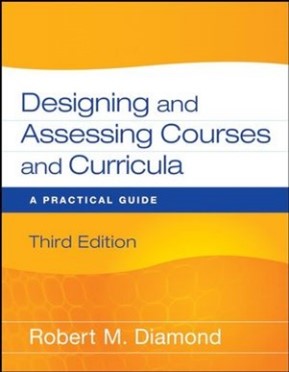 Designing and Assessing Courses and Curricula reflects the most current knowledge
and practice in course and curriculum design and connects this knowledge with the
critical task of assessing learning outcomes at both course and curricular levels.
This thoroughly revised and expanded third edition of the best-selling book positions
course design as a tool for educational change and contains a wealth of new material
including new chapters, case examples, and resources.
Designing and Assessing Courses and Curricula reflects the most current knowledge
and practice in course and curriculum design and connects this knowledge with the
critical task of assessing learning outcomes at both course and curricular levels.
This thoroughly revised and expanded third edition of the best-selling book positions
course design as a tool for educational change and contains a wealth of new material
including new chapters, case examples, and resources.
Using Evidence of Student Learning to Improve Higher Education
- By: George D. Kuh, Stanley O. Ikenberry, Natasha A. Jankowski, Timothy Reese Cain, Peter T. Ewell, Pat Hutchings, Jillian Kinzie
- Published by: Jossey-Bass, January 2015
- ISBN: 9781118903391
Description:
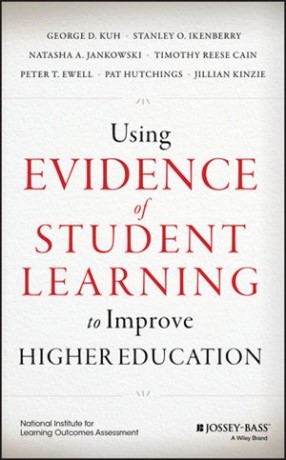 Today's circumstances demand a fresh and more strategic approach to the processes
by which evidence about student learning is obtained and used to inform efforts to
improve teaching, learning, and decision-making. Whether you are in the classroom,
an administrative office, or on an assessment committee, data about what students
know and are able to do are critical for guiding changes that are needed in institutional
policies and practices to improve student learning and success.
Today's circumstances demand a fresh and more strategic approach to the processes
by which evidence about student learning is obtained and used to inform efforts to
improve teaching, learning, and decision-making. Whether you are in the classroom,
an administrative office, or on an assessment committee, data about what students
know and are able to do are critical for guiding changes that are needed in institutional
policies and practices to improve student learning and success.
Use this book to:
- Understand how and why student learning outcomes assessment can enhance student accomplishment and increase institutional effectiveness
- Shift the view of assessment from being externally driven to internally motivated
- Learn how assessment results can help inform decision-making
- Use assessment data to manage change and improve student success
Gauging student learning is necessary if institutions are to prepare students to meet the 21st century needs of employers and live an economically independent, civically responsible life. For assessment professionals and educational leaders, Using Evidence of Student Learning to Improve Higher Education offers both a compelling rationale and practical advice for making student learning outcomes assessment more effective and efficient.
Integrating information literacy into the higher education curriculum : practical models for transformation
- By: Ilene F Rockman
- Published by: Jossey-Bass, 2004
- ISBN: 9780787965273
Description:
 Research has shown that in order to develop information literacy skills, students
must be given repeated opportunities throughout their college years to acquire and
exercise these skills in their daily lives. Integrating Information Literacy into
the Higher Education Curriculum is filled with information and practical examples
from a wide variety of institutions that show how information literacy programs and
partnerships can transform the higher education teaching and learning environments.
The contributors to this important resource are experts in the field and include such
leaders as Pam Baker, Amelie Brown. Lynn Cameron, Renee R. Curry, Susan Carol Curzon,
Trudi E.Jacobson, Bonnie Gratch Lindauer, Ilene F. Rockman, and Patrick Sullivan.
The Foreword is by Patricia Senn Breivik.
Research has shown that in order to develop information literacy skills, students
must be given repeated opportunities throughout their college years to acquire and
exercise these skills in their daily lives. Integrating Information Literacy into
the Higher Education Curriculum is filled with information and practical examples
from a wide variety of institutions that show how information literacy programs and
partnerships can transform the higher education teaching and learning environments.
The contributors to this important resource are experts in the field and include such
leaders as Pam Baker, Amelie Brown. Lynn Cameron, Renee R. Curry, Susan Carol Curzon,
Trudi E.Jacobson, Bonnie Gratch Lindauer, Ilene F. Rockman, and Patrick Sullivan.
The Foreword is by Patricia Senn Breivik.
Do you find this content helpful?
عفوا
لايوجد محتوى عربي لهذه الصفحة
عفوا
يوجد مشكلة في الصفحة التي تحاول الوصول إليها